
The Invisible Grid: Why the 9-Box System Is a Systemic Barrier for Culturally Diverse Leaders in Australia
Quick answer: The 9-box grid is Australia's most common talent-review tool, plotting staff on performance and potential to decide who gets promoted, developed and put on the succession plan. Its “potential” axis is unmeasurable and relies on subjective judgement — and Australian research shows that judgement is consistently shaped by Anglo-coded leadership traits, which is why culturally diverse employees are promoted at persistently lower rates even after controlling for performance, tenure and role.
Most people who work in a large Australian organisation have never seen their 9-box rating. But it has likely shaped their career anyway.
The 9-box grid is the tool many corporates and public sector agencies use behind closed doors to decide who gets called “high potential,” who gets the stretch assignment, and who makes the succession plan. It looks clinical: two axes, nine boxes, a clean plot of performance against potential. For culturally diverse leaders in Australia, it is worth understanding exactly how this tool works — because the grid is not neutral, and the gap it leaves behind is not closing on its own.
What Is the 9-Box Grid and How Is It Used in Australian Workplaces?
Developed originally at McKinsey and now standard across large employers, the 9-box grid plots every employee on two dimensions: current performance (low, moderate, high) and future potential (low, moderate, high). The resulting nine boxes range from “bad hire” (low-low) to “star” (high-high), with labels like “core player,” “workhorse,” and “high potential” in between.
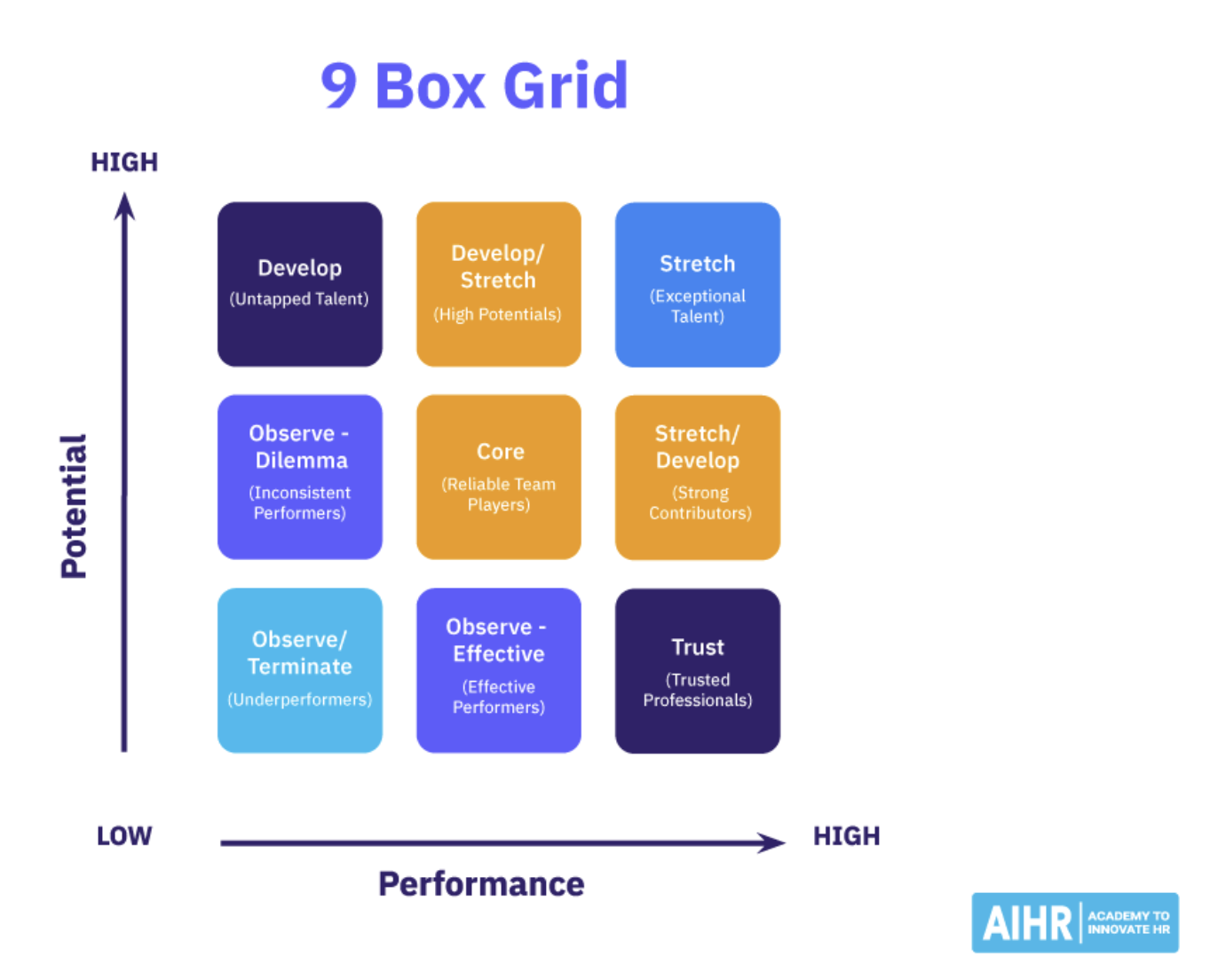
How performance is defined. Performance is scored against how well someone meets the requirements of their current role and hits their individual targets, usually on a three-point scale — low (fails to meet role requirements and targets), moderate (partially meets them), or high (fully meets them) — though some organisations use a four-point scale to stop managers defaulting everyone to “moderate.” This is the more evidence-based half of the grid: KPIs, outputs and targets can usually back up the rating.
How potential is defined. Potential is a forecast of future capability, typically scored the same way: low potential (already working at full capacity, not expected to grow further), moderate potential (able to develop further within the current role), or high potential (ready for a higher position and naturally and enthusiastically take on leadership roles) — it is a judgement call about who “looks like” future leadership material, made by people who already hold leadership roles.
In theory, it’s a shortcut to fairer, more holistic talent decisions — no one gets promoted on performance alone, or potential alone. In practice, the rating happens in a closed-door “calibration” meeting, where a manager or panel debates where each person sits, often once a year, based on largely subjective judgement.
Why Is the 9 Box Grid a Systemic Barrier for Culturally Diverse Leaders in Australia?
Evidence isn’t consistently required. In principle, a performance rating should be backed by targets, output and KPIs. In practice, calibration meetings frequently accept a manager’s word on someone’s performance without that evidence being consistently requested, documented or checked. The “objective” side of the grid often ends up just as subjective in application as the “potential” side is by design.
Culturally diverse employees report clearing a higher bar for the same rating. DCA’s research found 85% of surveyed culturally and racially marginalised women felt they had to work twice — sometimes three times — as hard as their peers just to receive the same performance evaluation. This means identical output can translate into a lower recorded rating, or the same rating can demand substantially more evidence from culturally diverse employees.
And clearing that higher bar doesn’t reliably lead anywhere. Even when culturally diverse employees do score highly on performance, they are disproportionately likely to be filed under “high performance, low or moderate potential” — the “workhorse” or “core player” boxes — rather than being moved toward “star.”
So why does “potential” carry this bias so consistently? Two mechanisms tend to combine.
Preference for Anglo norms. The prototype for what “future leadership” looks like in Australian organisations — assertive, extroverted, self-promoting, a nebulous executive presence and gravitas — is Western and Anglo-coded. The further away the person from that prototype the lower the potential is assessed, rather than simply different or even considered as an asset.
Familiarity bias among decision-makers. Calibration panels and senior sponsors tend to rate people who remind them of themselves, or who they already know socially, more favourably — a well-documented affinity or in-group bias. Since senior decision-makers in Australian workplaces remain overwhelmingly Anglo-Celtic, this familiarity effect systematically favours candidates who share that background, regardless of the criteria on paper.
The gap isn’t closing with time or seniority — it’s widening. A 2026 study of the full 20-year Australian Public Service dataset (Breunig, Hansell and Win) found that promotion prospects for staff from non-English-speaking backgrounds have stagnated or worsened over two decades, even as gender-based promotion gaps improved substantially following targeted policy action. Notably, staff born in Asia remain among the most underrepresented at executive level — even those born in Australia or who arrived before school age. That points to race, not language or migration recency, as the driver.
This is similarly found in the private sector by the Australian Human Rights Commission’s Leading for Change research found that while people with a non-European or Indigenous background make up around 24% of the population, they hold only about 5% of senior leadership roles across ASX-listed companies, the public service and universities. Anglo-Celtic and European backgrounds account for roughly 95% of senior executives.
How Can Culturally Diverse Leaders Navigate the 9-Box Grid?
The fix for a biased system is a better system — structured rubrics, diverse calibration panels, decoupling “potential” from cultural style. That work belongs to organisations, not to individuals carrying the disadvantage. But while that work is (slowly) underway, here is what you can do with the grid as it stands today.
Learn how your organisation actually runs calibration.
Ask directly: who is in the room, how often does it happen, and what evidence is used to justify a potential rating. You cannot navigate a process you can’t see.
Manufacture your own exposure.
Don’t wait to be handed the visible project. Identify promotable opportunities be it high-profile client-facing work, the cross-functional initiative, the chance to present to senior stakeholders. Potential ratings are shaped by who gets seen — so treat visibility as a deliberate career input, not a reward for good work.
Find a sponsor, not just a mentor.
Research by Sylvia Ann Hewlett in the United States found 20% of white employees have a workplace sponsor, compared with just 5% of Black employees — yet those who do have one see real gains.A mentor gives advice; a sponsor spends their own credibility advocating for you in rooms you’re not in. Seek that relationship out explicitly, and where your organisation runs a sponsorship program, put your name forward.
Push for specificity, not vibes.
When feedback about your “potential” or “readiness” is vague — comments about presence, communication, tone, fit, or style — ask for the specific evidence and criteria behind it. Vague feedback is where bias hides; specific, criteria-based feedback is harder to weaponise and easier to act on.
Communicate your own record.
Document your outcomes, contributions and the opportunities you weren’t given, independently of what any single calibration conversation says about you. A written track record only guards against being permanently defined by one label from one meeting if the right people actually see it — so articulate your contribution and impact directly to decision-makers, rather than assuming it will speak for itself.
Conclusion
The 9-box grid isn’t going away soon. But understanding exactly where its blind spot sits — in the unmeasurable, culturally-coded “potential” box — is the first step to making sure it doesn’t quietly write your ceiling for you.
Frequently Asked Questions
What is the 9-box grid used for?
Organisations use it for performance calibration, talent management and succession planning — plotting employees on performance and potential to decide who receives development investment, promotion and stretch opportunities.
What's the difference between a sponsor and a mentor?
A mentor gives advice. A sponsor actively advocates for you — recommending you for promotions and stretch assignments and spending their own credibility on your behalf. DCA research found sponsorship, not mentoring alone, is what most reliably moves professionals of colour into senior roles.
Is it legal for Australian employers to run development programs targeted at culturally diverse staff?
Yes. Sponsorship and targeted development programs for culturally and racially marginalised employees are recognised as lawful “positive action” under Australian anti-discrimination law, distinct from quotas or positive discrimination.
How can I find out how I've been rated on my organisation's 9-box grid?
Most organisations don't share individual placements by default. Ask your manager or HR directly how calibration works, who is in the room, and what evidence supports potential ratings — you're entitled to ask, even if it isn't automatically disclosed.
What should I do if I've been told I have “low potential”?
Ask for the specific evidence behind the rating rather than accepting vague feedback about presence or fit. Then focus on gaining visibility through stretch assignments and high-profile work, and on finding a sponsor — both are shown to shift potential ratings more than performance alone.
Sources
Australian Human Rights Commission (2018), Leading for Change: A Blueprint for Cultural Diversity and Inclusive Leadership Revisited. https://humanrights.gov.au/our-work/race-discrimination/publications/leading-change-blueprint-cultural-diversity-and-0
Breunig, R., Hansell, D. and Win, N.N., ‘Promotion in the Australian Public Service: Improvements for Women and Stagnation for Cultural and Linguistic Minorities,’ Economic Record (see also the earlier IZA/TTPI working paper, ‘Modelling Australian Public Service Careers’). https://docs.iza.org/dp16549.pdf
Diversity Council Australia (2023), Culturally and Racially Marginalised Women in Leadership: A Framework for (Intersectional) Organisational Action. https://www.dca.org.au/research/culturally-and-racially-marginalised-carm-women-in-leadership
Hewlett, S.A. and Jackson, M., Vaulting the Color Bar: How Sponsorship Levers Multicultural Professionals into Leadership, Center for Talent Innovation / Coqual. https://coqual.org
Van Vulpen, E., The 9 Box Grid: A Practitioner’s Guide, AIHR. https://www.aihr.com/blog/9-box-grid
